
Presentation

This is the home page of the project “Se4GenAI: Software Engineering methods and tools for systems embedding Generative Artificial Intelligence“. The goal of the project is to make the promise of open data a reality by giving non-technical users tools they can use to find and compose the information they need.

This work has been supported by the Spanish Ministry of Science, Innovation and Universities under the call “Agencia Estatal de Investigación” and the European Union through the European Regional Development Fund (FEDER), under project PID2023-147592OB-I00.
This 3-year project will be undertaken from September 2024 to August 2027.
Summary
Artificial Intelligence, and more specifically Generative AI (GenAI), is experiencing an unprecedented explosion in adoption. Breakthroughs in Large Language Models (LLMs) like ChatGPT and Gemini have set records as the fastest-growing consumer applications in history, driving billions in investment and reshaping the tech industry. The disruption is moving fast: market forecasts project that by 2026, 80% of enterprises will have integrated generative AI APIs or deployed GenAI-enabled applications. The promise of GenAI is massive, offering software systems rich natural language interfaces, automated content creation, and unprecedented adaptability.
Unfortunately, software development is a complex endeavor, and embedding GenAI capabilities introduces a wave of entirely new, specialized engineering challenges. Unlike traditional software—or even traditional AI—GenAI systems operate largely as black boxes. They suffer from unpredictable outputs (hallucinations), severe security vulnerabilities (like prompt injection), and a lack of transparency from third-party Software-as-a-Service (SaaS) providers. Furthermore, continuous large-scale testing of these resource-heavy models is heavily restricted by massive computational, financial, and ecological costs. Currently, developers are forced to integrate these powerful models without structured engineering paradigms, risking system reliability, security, and cost efficiency.
The SE4GenAI research project aims to change this. Our goal is to provide the specialized engineering methods, architectures, and tools required to seamlessly and safely support software systems that embed GenAI capabilities. Focusing our efforts on systems utilizing LLMs and text-based multimodal inputs, this project will cover the entire application lifecycle—from initial model selection to deployment, testing, and continuous lifecycle monitoring. By bridging the gap between raw AI capabilities and rigorous software engineering, we will transform GenAI integration from an unpredictable art into a reliable, structured discipline.
To achieve this ambitious goal, the project will pursue the following key research contributions:
-
Model Selection & Suitability Evaluation: Because of the open-ended nature of LLMs, it is difficult to know if a model fits a specific domain. We will develop frameworks to systematically evaluate and select the most appropriate GenAI tool or service for a given application’s unique requirements.
-
Systematic Prompt Engineering: The design of an input prompt is critical to an application’s success. We will create methods and tools to support the systematic design, optimization, and reuse of effective prompts across various GenAI platforms.
-
Black-Box Testing & Optimization: Traditional test coverage metrics fail when applied to non-deterministic AI. We will design novel testing methodologies that can assess system reliability and manage the massive computational and environmental costs of large-scale GenAI testing.
-
Behavioral Monitoring & Drift Management: Since many LLMs are managed by third parties who update their models without warning, application performance can degrade overnight. We will build monitoring tools to track model drift, detect hidden biases, and ensure long-term stability and cost control.
-
GenAI Security & Robustness: GenAI systems are uniquely vulnerable to novel cyberattacks. We will develop architectural defenses and guardrails to mitigate risks like prompt injection, ensuring that malicious inputs cannot trick the underlying model into unauthorized actions.
The results of this project will have a massive impact on the software industry by giving enterprises and development teams a safe, predictable, and cost-effective blueprint for adopting GenAI. Software companies will finally have a structured framework to build next-generation applications without sacrificing security or predictability. The benefits of the SE4GenAI framework will be validated through real-world case studies across diverse enterprise application domains, implemented on top of an open-source platform and toolset released by the project.
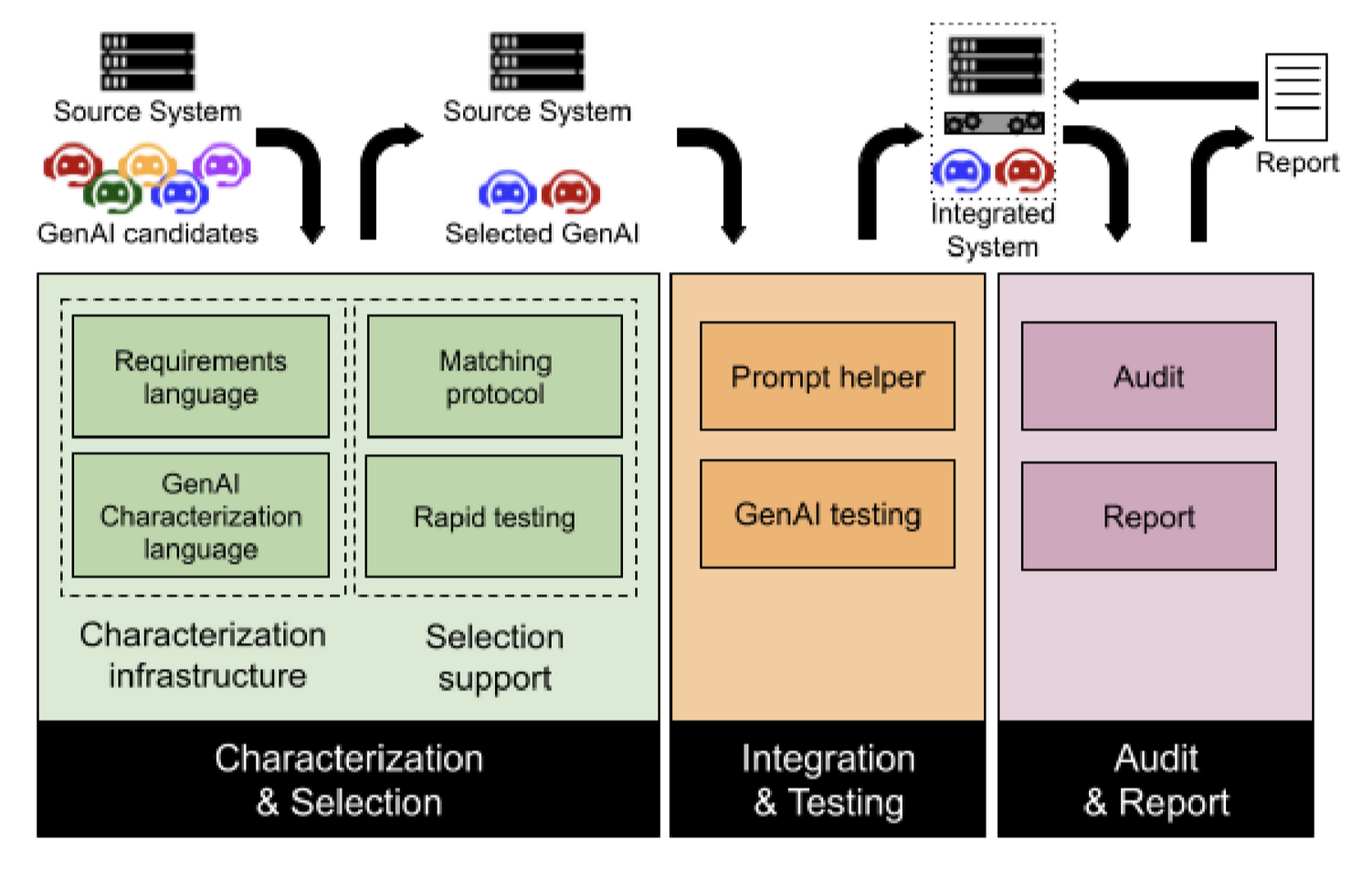
The following figure illustrates the proposed approach.
Project members
- Principal Investigator: Robert Clarisó Viladrosa
- Principal Investigator: Javier Luis Cánovas Izquierdo
- José (Josep) Curto Díaz
- M. Elena Rodríguez González
- Ana Elena Guerrero Roldán
- Elena Planas Hortal
- Josep Maria Marco Simó
- David Bañeres Besora
- Abel Gómez Llana
- Joan Giner Miguelez
- Sergio Morales García
- Juan Antonio Gomez
- Jordi Cabot Sagrera
- Salvador Martínez Pérez
- Manuel Wimmer
- Antonio Bucchiarone
- Sergio Cobos
- David Eduardo Delgado Camacho
- Anargyros Kiourkos
- Diego Felipe Martínez Valencia
- Rubén Rodríguez Paz
- Jorge Martín Villafruela
- Raquel Berenguer Mueller
Publications & Tools
- David Delgado, Lola Burgueño, Robert Clarisó: A framework for assessing the capabilities of code generation of constraint domain-specific languages with large language models. Journal of Systems and Software. 238: 112871 (2026) – Github
- Joan Giner-Miguelez, Sergio Morales, Sergio Cobos, Javier Luis Cánovas Izquierdo, Robert Clarisó, Jordi Cabot: The Software Diversity Card: A framework for reporting diversity in software projects. Inf. Softw. Technol. 190: 107950 (2026) – Github
- Fernando Ares-Robledo, Helena Rifà-Pous, Robert Clarisó: Graph neural networks for anomaly detection: a systematic review of dynamic temporal approaches. Artificial Intelligence Review 59(5): 129 (2026)
- David Bañeres, Ana-Elena Guerrero, M. Elena Rodríguez: Recomendador de evaluación para preguntas cortas utilizando modelos de lenguaje en propiedad intelectual. Revista Iberoamericana de Educación a Distancia (RIED). 29(1): 2026
- Sergio Morales, Robert Clarisó, Jordi Cabot: LangBiTe: An open-source platform to automate bias testing of large language models. SoftwareX 31: 102248 (2025) – Github
- Mauro Dalle Lucca Tosi, Javier Luis Cánovas Izquierdo, Jordi Cabot: A Metascience Study of the Low-Code Scientific Field. Journal of Object Technology 24(2): 2 (2025)
- Raquel Berenguer, Sergio Cobos, Javier Luis Cánovas Izquierdo, Robert Clarisó. Assisting Developers in the Selection of Generative AI Models. 5th International Conference on AI Engineering – Software Engineering for AI (CAIN’2006), to appear, ACM
- David Delgado, Lola Burgueño, Robert Clarisó: How much does an LLM know about my programming language? 19th ACM SIGPLAN International Conference on Software Language Engineering (SLE’2026), to appear, ACM. – Github
- Anargyros Kiourkos, Javier Luis Cánovas Izquierdo, Robert Clarisó: Automatic Security Testing of System Prompts Against Prompt Injection Attacks. 20th International Conference on Research Challenges in Information Systems (RCIS’2026): – Github
- Juan Antonio Gómez-Gutiérrez, Robert Clarisó: Interactive Repair of Inconsistencies in Conceptual Models. 44th International Conference on Conceptual Modeling (ER 2025): 3-23 (2025) – Github
- Sergio Morales, Robert Clarisó, Jordi Cabot: ImageBiTe: A Framework for Evaluating Representational Harms in Text-to-Image Models. 4th International Conference on AI Engineering – Software Engineering for AI (CAIN 2025): 95-106 (2025) – Github
- Renzo Degiovanni, Sergio Morales, Miriam Coccia, Robert Clarisó and Jordi Cabot. Robust LLM-as-a-Judge Validators for Assessing the Quality of Educational Exams. 41st ACM/SIGAPP Symposium On Applied Computing (SAC 2026): 95-102 (2026)